The appearance of calm and what lies beneath. A layered paper composition exploring the tension between visual simplicity and the complexity of the systems, decisions and relationships behind a designed experience.
What is Calm Design, what isn’t, and why we need to be careful about the difference.
There is something I don’t think we talk about enough when developing a design practice with an ethical direction: what happens when the ideas we have been working on start gaining traction, but the underlying thinking doesn’t necessarily come along with them.
Over the last few months, I’ve been noticing an increasing interest in Calm Design. More companies, designers and organisations are exploring the concept, using the terminology and looking for ways to incorporate it into their products and services.
I’m genuinely happy to see this happening. After all, I’ve spent the last eight years researching and developing ways to bring attention care into design practice. Seeing these conversations become more widespread is part of what I’ve been working towards.
But alongside this interest, I’ve also been noticing some practices that make me increasingly uncomfortable. I’ve encountered companies approaching Calm Design as something they can add to their communication without necessarily changing anything about their product. The interest seems to be less about examining their design decisions and more about obtaining some kind of endorsement, certification or public association with being calm and responsible with people’s attention.
I’ve seen people equating Calm Design with changing an interface’s background to white, using black typography and adding some whitespace. I’ve seen wellness-oriented products and services promoting calm and wellbeing while seemingly overlooking the working conditions and organisational practices behind them. I’ve seen approaches that skip research altogether in favour of last-minute visual interventions, presented as a Calm Design transformation. And I’ve noticed how easily calm can become another selling point: another word to put on a website, another feature to add to a product description, another way to position a company as more responsible, mindful or human-centred.
I think we need to talk about this.
Calm is not simply a matter of removing visual noise. It requires examining what lies beneath the surface and how different elements interact to shape attention.
When Calm Becomes a Marketing Strategy
I would call some of these practices calm washing. By this, I mean the appropriation of Calm Design language, aesthetics or principles to communicate responsibility towards people’s attention without making a meaningful effort to examine or change the underlying design practices.
It is not necessarily intentional. Sometimes it comes from a genuine interest in the subject, but a limited understanding of what it involves. Other times, it is simply an opportunity to capitalise on an emerging trend. Either way, the result is similar: calm becomes a label rather than a design responsibility. And this is where I think we need to be careful.
Calm Design isn’t a visual style that can be applied to an existing product. It isn’t a collection of aesthetic decisions or a set of features that can be added at the end of a development process. It isn’t something you can claim simply because you’ve reduced notifications, introduced a meditation mode or made your interface look less stimulating.
These decisions might contribute to a calmer experience. They might even be valuable starting points. But they don’t tell us enough about how a product actually relates to people’s attention. To understand the difference, we need to go back to the question of what Calm Design actually is.
Layers of visual order and disruption. An exploration of the contrast between the appearance of calm and the underlying structures that shape our experience of attention.
So, What is Calm Design?
Calm Design is an approach to designing products, services and environments that takes responsibility for how design shapes human attention.
It considers the conditions under which attention is invited, captured, sustained, shared, interrupted, restored or allowed to disengage. It looks beyond the immediate interaction to examine the broader relationships between time, space, the body, agency and social ecology.
It asks questions that go beyond whether an experience looks or feels calm:
- What state of attention does this experience invite people into?
- What does it ask of their time and cognitive resources?
- Does it support their agency and their ability to disengage?
- What happens to their attention before, during and after interacting with it?
- What kind of relationship does it establish between people, technology and their surroundings?
- Who benefits from the attention being generated, and who bears the cost?
These questions matter because attention doesn’t exist in isolation. It is embodied, situated and shaped by the environments, relationships and systems we participate in.
A product can look incredibly calm while relying on mechanisms that encourage compulsive engagement. A service can promise wellbeing while creating unnecessary cognitive demands. An environment can be visually minimal but leave people with very little agency over how they spend their time. Calm Design asks us to look at these relationships rather than judging an experience by its surface appearance.
And importantly, Calm Design isn’t about making everything quiet, slow or minimal. Sometimes stimulation, intensity, complexity and deep engagement are exactly what an experience needs. Curiosity, exploration, excitement and flow are valuable attentional states too.
The question isn’t whether an experience is stimulating or relaxing. It’s whether the conditions it creates are appropriate, meaningful and respectful of the people engaging with it.
And What isn’t Calm Design?
I think it is equally important to make some things explicit. Calm Design is not:
A visual aesthetic. Muted colours, rounded corners, generous whitespace, natural textures and soft typography can all contribute to a particular atmosphere. But they don’t automatically make a product calm.
A collection of wellbeing features. Adding meditation exercises, screen-time reminders or notification controls while leaving the underlying engagement mechanisms untouched doesn’t necessarily address the problem.
An individual responsibility. Telling people to manage their attention better, practise mindfulness or take more breaks while ignoring the design decisions and business models that continuously compete for their attention shifts responsibility in the wrong direction.
A marketing claim. Using calm, mindful or attention-friendly language to position a product without examining how it operates is precisely the kind of practice that risks turning Calm Design into calm washing.
A last-minute intervention. Research, critical reflection and experimentation cannot always be replaced by an aesthetic redesign at the end of a development process.
A universal solution. People don’t experience attention, stimulation or calm in the same way. Cultural, social, individual and contextual differences matter. There is no single recipe for a calm experience.
A guarantee of ethical practice. A product designed with attention care in mind doesn’t automatically make the organisation behind it responsible. We also need to consider the people developing, maintaining and delivering that product, the conditions under which they work and the wider systems in which it operates.
Ultimately, Calm Design isn’t about whether something looks or feels calm at first glance. It’s about what it does with people’s attention and the conditions it creates around it.
What appears on the surface rarely tells the whole story. A visual exploration of the hidden layers, decisions and structures that shape designed experiences.
The First Step is Wanting to Do Things Differently
I also want to be fair about something. I don’t believe that every organisation approaching Calm Design needs to have all the answers from day one. I don’t expect every designer to understand the full scope of the research or to have the resources to implement every possible intervention.
And I certainly don’t think that every project needs to follow exactly the same process. In fact, one of the things I often say when introducing Calm Design to a new project is that the first step is simply wanting to explore it. Wanting to question existing practices. Wanting to understand how a product or service affects people’s attention. Wanting to make changes, even when those changes are initially small.
Different industries, products, services and environments have different constraints and opportunities. The way we approach a digital platform will not be the same as the way we approach a public space, a healthcare service or an educational environment. What matters is the willingness to investigate, experiment and take responsibility for the consequences of our design decisions.
There is a difference between starting somewhere and pretending that you’ve arrived. I have absolutely no problem with people experimenting with Calm Design, interpreting it through their own contexts or challenging the methodologies being developed. That’s how research progresses. What concerns me is when the language becomes detached from the work.
Why I’m Opening Up My Research
This brings me to another decision I’ve been thinking about for a while.
Over the last eight years, I’ve been developing research, frameworks, tools and methodologies around Calm Design through my independent research practice at Calm Design Lab. Some of this work has been tested through research projects, collaborations and design practice. Some of it is still evolving, being questioned and refined. There are things I consider relatively established, and others for which I still have more questions than answers.
As AI makes it increasingly easy to reproduce, summarise and repackage ideas, I’ve been reconsidering what it means to protect this kind of work. And I’ve decided to take a different approach.
Rather than keeping everything behind closed doors, I’m making the research and resources developed at Calm Design Lab openly available through the website. This includes the tools and methodologies I’ve been working on, as well as research that is still in progress.
I want people to be able to explore how these approaches work, understand the thinking behind them, use them in their own projects, question their assumptions and contribute to their development.
I also want to make a distinction between sharing a set of principles and sharing actual research. I’m interested in making the process visible: the questions, the experiments, the feedback loops, the limitations and the things that still need to be tested. Not just publishing polished conclusions or presenting a framework as a finished solution.
I would rather see these ideas understood, challenged, tested and developed than reduced to another collection of principles that people can copy and put on a slide.
Making research openly available doesn’t mean that the work is finished or that every interpretation will be equally meaningful. Quite the opposite. It means making room for scrutiny, discussion and further development.
And perhaps, in a context where ideas can be reproduced so easily, the value of research lies even more in the depth of the investigation, the quality of the questions and the willingness to keep testing what we think we know.
Let’s Make Calm Design Mean Something
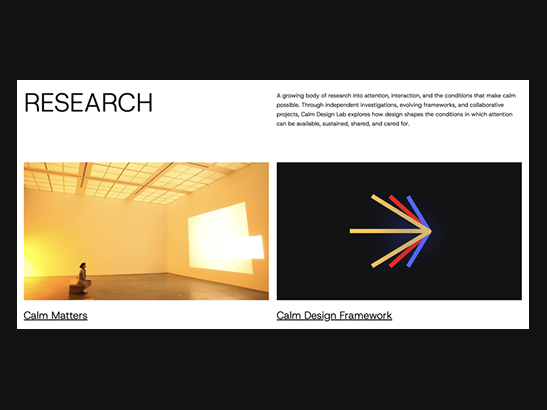
A growing body of research into attention, interaction, and the conditions that make calm possible. Through independent investigations, evolving frameworks, and collaborative projects, Calm Design Lab explores how design shapes the conditions in which attention can be available, sustained, shared, and cared for.
I’m genuinely excited to see more people exploring Calm Design. I want the conversation to grow, reach different disciplines and find its way into more products, services and environments. But I also think we have a responsibility to be critical about how we use the terminology and what we associate with it.
Calm Design should not become another marketing category, another visual trend or another way of making products appear more ethical without questioning how they actually operate. If we’re going to talk about caring for people’s attention, we need to be willing to examine the systems, decisions and relationships that shape it.
And if we’re going to call something Calm Design, we should be able to explain what that means, what we’ve investigated, what we’ve changed and what we still don’t know. That’s the kind of conversation I want Calm Design Lab to contribute to.
If you’re interested in following this research, exploring the tools and seeing how the methodologies develop, I’ll be progressively publishing the research, resources and tools on the Calm Design Lab website as the work evolves. This includes both established methodologies and ongoing research, so you can follow the process as it unfolds.
You can also subscribe to the newsletter. It won’t be a marketing newsletter. I’ll be sharing research developments, tools, resources, experiments and practical things you can explore and test in your own projects. Once or twice a month, and always with something useful to take away.
Because I don’t think we need more products claiming to be calm. We need more design practices that take responsibility for people’s attention.